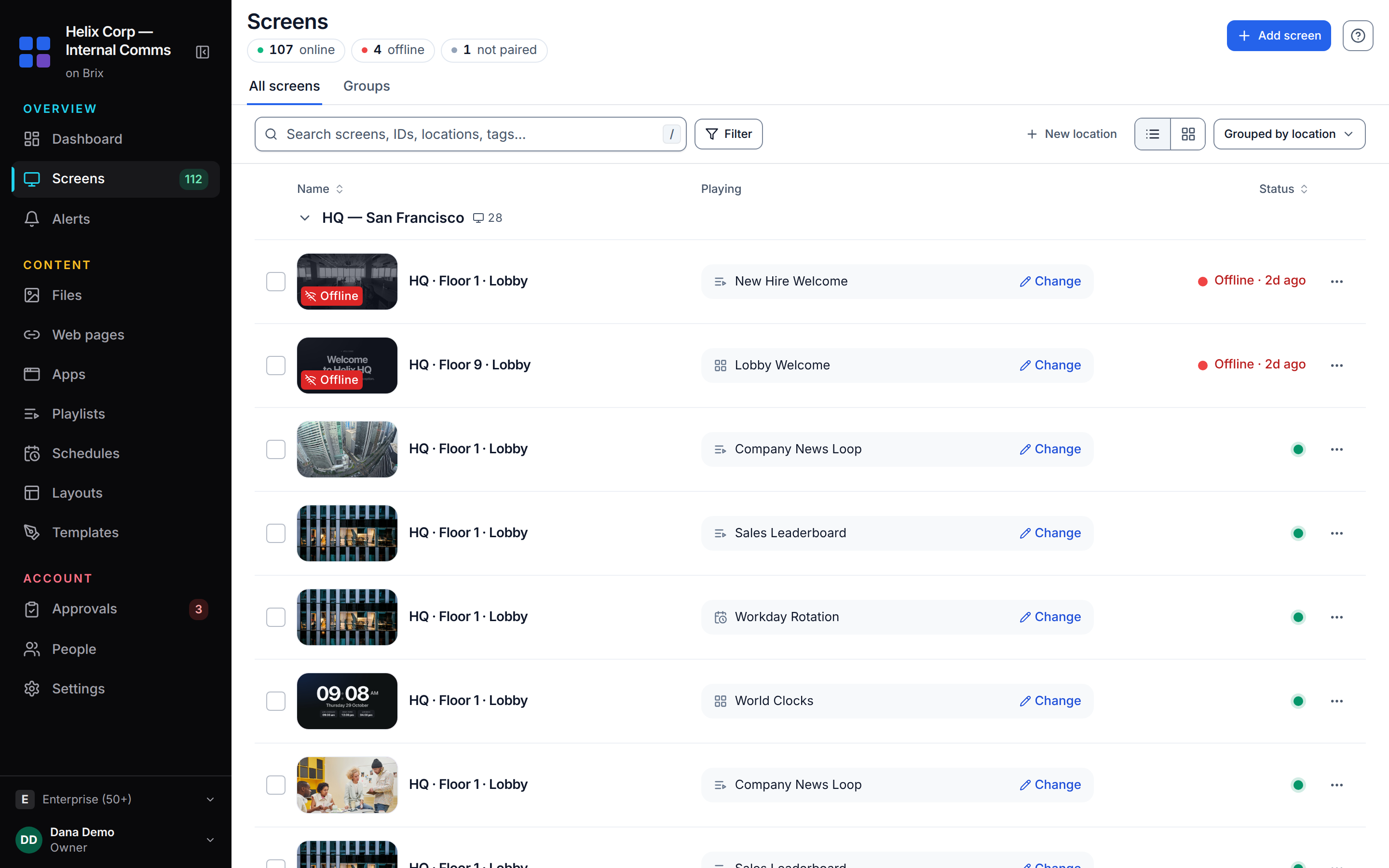
Brix, Screenly, Xibo, Yodeck, OptiSigns and ScreenCloud are six alternatives to Scala, each with a price on its own site. Scala sells through partners: resellers list a Scala PC Player licence at about $810 to $840 one-off, or $360 a year as a subscription, before the Content Manager server and maintenance.
Who owns Scala, and is it still supported?
Vertiseit bought Scala from STRATACACHE. Vertiseit announced the deal in May 2026 for about SEK 265 million, and completed it in June 2026.
- Who runs it: Scala is part of Dise, a Vertiseit company. Dise then took the Scala name for the whole organisation, headquartered in Varberg, Sweden.
- Software support: Scala says the existing Dise and Scala platforms "will continue to be developed and supported." Scala Enterprise 13.60 added Windows 11 support. Updates go only to customers under current maintenance.
- How you buy it: Scala's About page says it is "software-only, partner-only". You buy licences and support through a Scala partner, not direct.
- Where licensing is going: Vertiseit plans "a gradual transition from traditional perpetual licensing toward a true SaaS offering" that is "device-agnostic".
- Hardware: Scala's own media players are still on its site, but Screenly says several models were discontinued before the sale and nobody is building a future for the line.
What Scala is made of
Scala Enterprise has three parts, and a replacement has to cover each one:
- Content Manager: a server application that you or your partner host. Its spec sheet lists Microsoft SQL Server or PostgreSQL as the database, approvals, workgroups, user roles, emergency override, player metadata, and up to four separate channels from one player.
- Designer: an authoring tool for templates, transitions, video walls and ScalaScript (or VBScript, JavaScript and Python).
- Scala Player: playback software for Windows and Linux. It keeps playing from local storage when the network drops, downloads only changed files and logs plays for ad billing.
Why people look for a Scala alternative
- Several bills, not one. A player licence per screen, a server for Content Manager, an annual maintenance contract for updates, and paid help-desk incidents.
- Sold through partners. No self-serve sign-up and no price on scala.com.
- A server to run. Content Manager is a server application with its own database (Microsoft SQL Server or PostgreSQL), run by you or your partner.
- Aging player hardware. Screenly, which reimages Scala players, says Scala's hardware business is winding down.
What does Scala digital signage cost?
Scala's own site shows no prices. Reseller listings and a public university page do:
- PC Player licence (part SW-PLAD), one-off: $839.03 at Superwarehouse, $809.47 at HSSL.
- PC Player subscription, per year: $360 list, $283.26 at Superwarehouse (part TLPLAD). That is $30 per screen per month at list.
- Set-up fee per subscription player: $30 list.
- Standard help-desk incident: $95 list, per incident.
- Player and licence bundle: HSSL lists the HD Lite bundle (Scala Media Player-L, Windows and an HD Lite licence) at $629.78.
- A real budget: Appalachian State University runs Scala and tells departments to budget $450 for a player licence and $800 to $900 for the PC that plays it (a Dell OptiPlex Micro). Its central IT pays the yearly maintenance for every player and the Content Manager.
Not on any public list: the Content Manager licence and the annual maintenance rate. Those come in a partner's quote.
For comparison, Brix is $6 per screen per month billed annually, or $8 billed monthly, with hosting and updates included. A Scala subscription at list ($30 per screen per month) costs five times Brix's annual price before the server and maintenance.
Scala alternatives compared
| Platform | Price (per screen per month) | Players | Best for |
|---|---|---|---|
| Scala | $360 a year list per subscription player, or about $810 to $840 one-off, plus server and maintenance | Scala Media Players (Windows 10 IoT or Linux), Windows and Linux PCs | Existing Scala networks with a partner |
| Brix | $6 annual, $8 monthly | Amazon Signage Stick, Fire TV, Android TV, Windows | Cloud-first teams replacing Scala without hiring IT to run it |
| Screenly | $15 annual, $17 monthly (Starter, up to 5 screens); $24 annual, $27 monthly (Business) | Screenly Player, Player Max Mk3, reimaged Scala players, Screenly Anywhere | Keeping existing Scala hardware running |
| Xibo | £3.50 to £9.00 (billed in GBP) | Self-hosted or hosted CMS; Android, webOS, Tizen, ChromeOS, Windows | Staying on your own servers, the way Scala works |
| Yodeck | $8 annual or monthly (Basic) | Signage Stick, Fire TV, Tizen, webOS, BrightSign, Windows, Yodeck player | Large fleets that mix several hardware platforms |
| OptiSigns | $9 annual, $10 monthly (Standard) | Amazon Signage Stick, Android, Windows, OptiSigns hardware | App-heavy screens, with a 3-screen free tier to pilot first |
| ScreenCloud | $20 annual, $24 monthly (Core) | ScreenCloud OS player, PIXI, Android boxes | Internal-communications-led teams at a larger company |
For a larger rollout, also see enterprise digital signage platforms.
The alternatives, one by one
Brix
Price: $6 per screen per month, billed annually, or $8 billed monthly. 7-day free trial, no card. Best for: A Scala replacement that a small team can run without dedicated IT, with the Amazon Signage Stick as the default hardware. Players: Amazon Signage Stick ($99.99), Fire TV, Android boxes (including the Walmart Onn), TVs with Google TV or Android TV built in, and the Windows player for any Windows 10 or 11 PC. Strengths:
- One plan, every feature, no quote and no server to run.
- Approvals, roles and audit log on the same plan, which covers the Scala Content Manager workflow.
- Brix places a new workspace's media, database and live connection in the region it signs up from (US, EU, Oceania or Asia-Pacific).
- Signage Stick setup takes about 10 minutes.
Watch out for:
- No on-premises or self-hosted CMS. Brix Edge, a free server you run on your own network, keeps documents there, but it covers one use case.
- No SAML (OpenID Connect only).
- No synced video wall across multiple screens, which Scala Designer does.
- The Windows player has fewer device controls than the Stick: no HDMI-CEC TV power.
Screenly
Price: Starter $15 per screen per month billed annually, $17 monthly (up to 5 screens, 1080p, 2 users). Business $24 annually, $27 monthly, from 1 screen. Enterprise is custom pricing from 25 screens. Best for: A business that already owns Scala media players and wants to keep them. Players:
- Screenly Player: Raspberry Pi 5 inside, 1080p, 90 x 65 x 27 mm, $219.
- Screenly Player Max Mk3: Intel Core 3 100U, 16 GB RAM, 500 GB storage, 4K, the same content on up to 4 screens, $699.
- Reimaged Scala players running ScreenlyOS, and Screenly Anywhere for Android, ChromeOS, Samsung Tizen and the Amazon Signage Stick.
Strengths:
- A free migration assessment and a 30-day pilot on up to ten players.
- A free Screenly Player for each new screen paid a full year on Business or Enterprise (US shipping, up to 25 per customer).
- Reimaged Scala players and Screenly players sit in one dashboard.
Watch out for:
- Only one Scala model is confirmed: the Player-SP (R1505G). The Player-S (R1305G) is "likely compatible"; the DX, Q, L, R and earlier S and SP need testing.
- The image comes from Screenly support, not a download, and installing it wipes the player's Scala content and settings.
- Custom user permissions and 4K start on Business; SAML and audit logs are Enterprise only.
Xibo
Price: Hosted plans are billed in GBP: Professional £3.50, Business £5.50 (SAML), Enterprise £9.00 per display per month. Self-hosting needs player licences (Android £20, webOS/Tizen £60, ChromeOS £35 one-time; the Windows player is free). Best for: A team that must keep the CMS on its own server, the way Scala Content Manager works. Players: Android, webOS, Tizen, ChromeOS and Windows, with a self-hosted CMS or Xibo's hosted cloud. Strengths:
- The CMS is open source (AGPLv3) and free to self-host.
- Xibo Cloud lets you pick the UK, Germany, US, Singapore or Australia for hosting.
Watch out for:
- Self-hosting keeps the work Scala gave you: your own server, backups, CMS updates and security patches, with community support only.
- Every price is in GBP; everything else on this list bills in USD.
Yodeck
Price: $8 per screen per month, the same billed monthly or annually (Basic); $12 (Premium); $16 (Enterprise). One screen free. Best for: A large fleet that already runs a mix of hardware and needs one CMS across all of it. Players: Amazon Signage Stick, Fire TV, Tizen, webOS, BrightSign, Windows, and Yodeck's own player (free with an annual plan). Strengths:
- An established company (180-plus people).
- More player hardware than most options here, which matters if a Scala fleet is already mixed.
- Its pricing page offers switchers 15 hours of free transition support.
Watch out for:
- Custom roles that restrict who can publish sit on Enterprise only, so the Scala approval workflow costs $16, not $8.
- Yodeck hosts in the EU only.
OptiSigns
Price: $9 per screen per month billed annually, $10 monthly (Standard); Pro Plus $13.50 annually, $15 monthly; Enterprise $40.50 annually, $45 monthly (25+ screens). Best for: A team that wants a large app library and a free tier to test before committing. Players: Amazon Signage Stick, Android, Windows, and OptiSigns' own players. OptiSigns is phasing out Fire TV support. Strengths:
- Free for up to 3 screens.
- 100+ apps and integrations, so most screen types need no custom build.
Watch out for:
- The free plan shows the OptiSigns logo and caps storage at 1 GB.
- Roles, approval workflow, audit logs and SAML, the closest match to Scala's enterprise controls, sit on Pro Plus and above.
ScreenCloud
Price: $20 per screen per month billed annually, $24 monthly (Core); $30 annually, $36 monthly (Pro); Enterprise is a quote. Best for: A larger organisation whose signage is run by the internal-communications team rather than IT. Players: ScreenCloud OS player ($199: Rockchip RK3399, 4 GB, 32 GB, Gigabit Ethernet), PIXI ($95: Android 14, 4 GB, 64 GB, Wi-Fi 5) and Android boxes. Strengths: Built around communications (announcements, dashboards, recognition), which fits a Scala network that was really an internal comms network. Watch out for: The highest entry price of the cloud options here, and SAML SSO is an Enterprise feature.
Can I keep running my existing Scala media players?
It depends on the model and its operating system. Scala's current players, from its own spec pages:
- Player-S: AMD Ryzen Embedded R1305G, 8 GB, 128 GB NVMe, one HDMI 2.0 (4K), Windows 10 IoT Enterprise LTSC or Linux.
- Player-SP: AMD Ryzen Embedded R1505G, 8 GB, 128 GB NVMe, two HDMI 2.0, Windows 10 IoT or Linux.
- Player-DX and Player-Q: AMD Ryzen V1202B, 8 GB, 128 GB SSD, two (DX) or four (Q) HDMI 2.0, Windows 10 IoT or Linux, 2.1 kg.
- Player-L Plus: Intel Atom x5-Z8350, 4 GB, 64 GB eMMC, one HDMI 1.4b (1080p), Windows 10 IoT Enterprise LTSB.
- Player-R: Rockchip RK3399, 2 or 4 GB, Linux only.
- NX4: quad-core ARM Cortex-A57, 4 GB, Linux only, built for outdoor signs.
Your options:
- Reimage it with Screenly. Best route for a Player-SP; other models are untested or "likely compatible" (see Screenly above).
- Install a Windows player on it. The Windows editions of the S, SP, DX, Q and L run Windows 10. Brix's Windows player runs on Windows 10 or 11, and Xibo and Yodeck also have Windows players. Try one player on a trial before you plan the fleet around it, and expect the Atom-based L to struggle with 4K video.
- Replace it. Linux-only models (R, NX4) cannot take a Windows player. A Signage Stick ($99.99) costs less than one Scala player licence.
Does Brix support on-premise like Scala?
No. Brix is cloud only; there is no self-hosted or on-premises version. Brix offers hosting-region placement instead: a new workspace's media, database and live screen connection sit in the US, EU, Oceania or Asia-Pacific, based on the country you sign up from, at no extra cost. The EU is the only one with a contractual data jurisdiction; the others are placement, not a guarantee.
Is there a free alternative to Scala?
Scala has no free tier. Yodeck's single-screen plan is free, and OptiSigns gives you 3 screens free with its logo on screen. Xibo's CMS is free to self-host, and its Windows player is free. Brix runs a 7-day free trial with no card, long enough to pair a Signage Stick and build a real playlist.
Moving off Scala
See how to switch digital signage providers for the general steps. Two Scala-specific points:
- Export first. Scala content lives in Content Manager and in each player's local store. Reimaging or reinstalling a player deletes its local copy, so pull your media and schedules out of Content Manager before you touch a player.
- Rebuild ScalaScript content. ScalaScript is Scala's own language and no platform on this list runs it. Rebuild scripted and data-driven templates as templates, web pages or apps in the new system.
If you choose Brix, migration is free, usually in a day: Brix moves your content, playlists and screens for you. Rolling out 30+ screens? Amazon gives you a free Signage Stick to test Brix; contact Brix through a demo and Brix arranges it.